

A paper journal won't catch the mistake. This will.
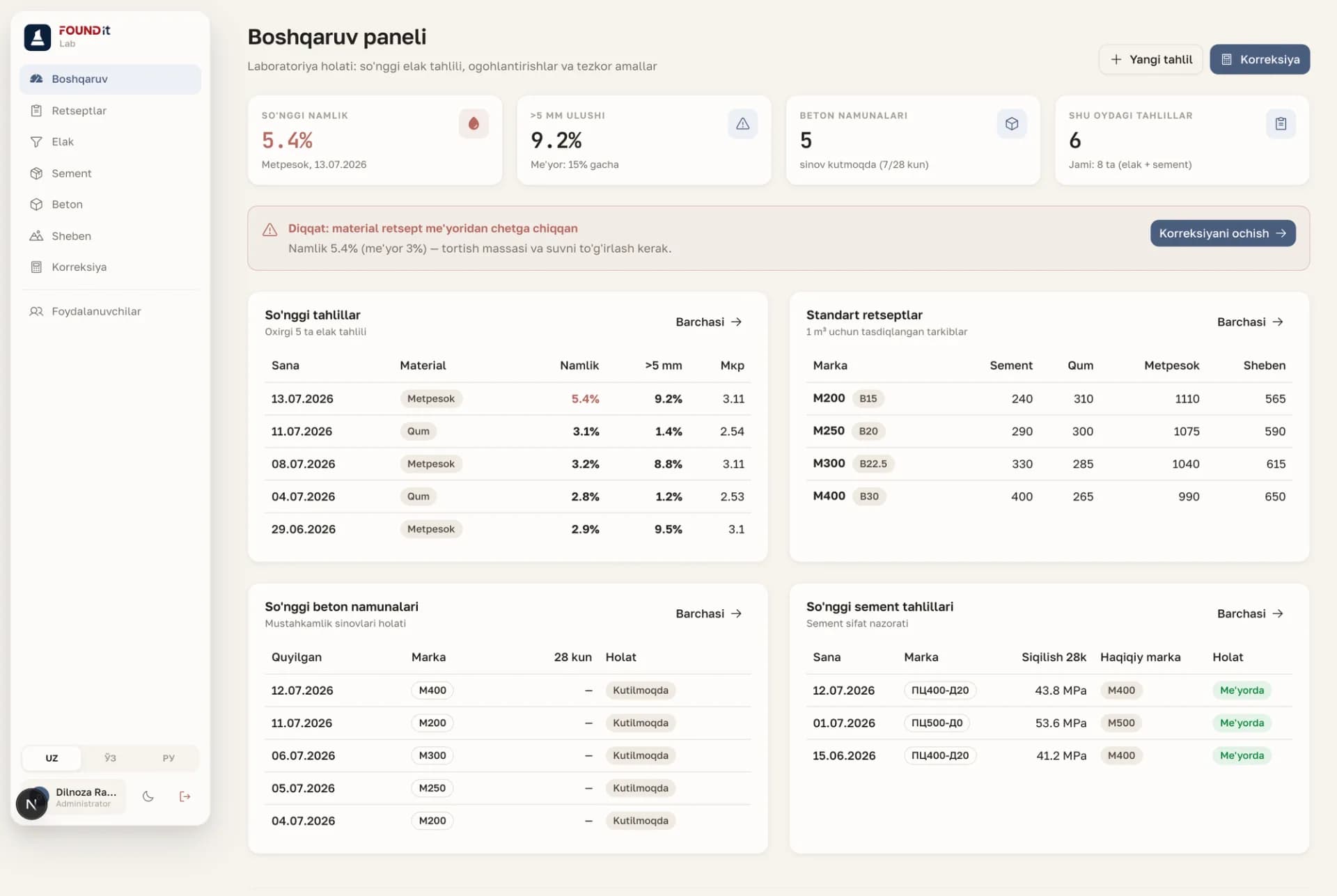
The technician enters the readings; the system produces the GOST verdict itself — sand class and fineness modulus, crushed-stone dust and flakiness, the cement's actual grade, the cube's MPa and strength class. And the part that pays for itself: exactly how much sand and water to adjust for today's moisture.
Capabilities
A plant lab's entire working day
Sieve analysis
Sand and crushed sand: moisture, sieve residues, fineness modulus, size group and class — a GOST 8736 verdict.
Cement testing
Normal consistency, setting times, 0.08 mm residue, flexural and compressive strength at 3/7/28 days. The actual grade is derived for you.
Concrete cubes
Enter the press readings in kN at 7 and 28 days — MPa, strength class and the pass/fail verdict follow automatically.
Crushed stone
Fraction, rock type, dust, clay lumps, weak grains and flakiness group — checked against the GOST 8267 limits.
Mix designs
Approved 1 m³ recipes: cement, sand, crushed sand, stone, water and admixture.
Batch correction
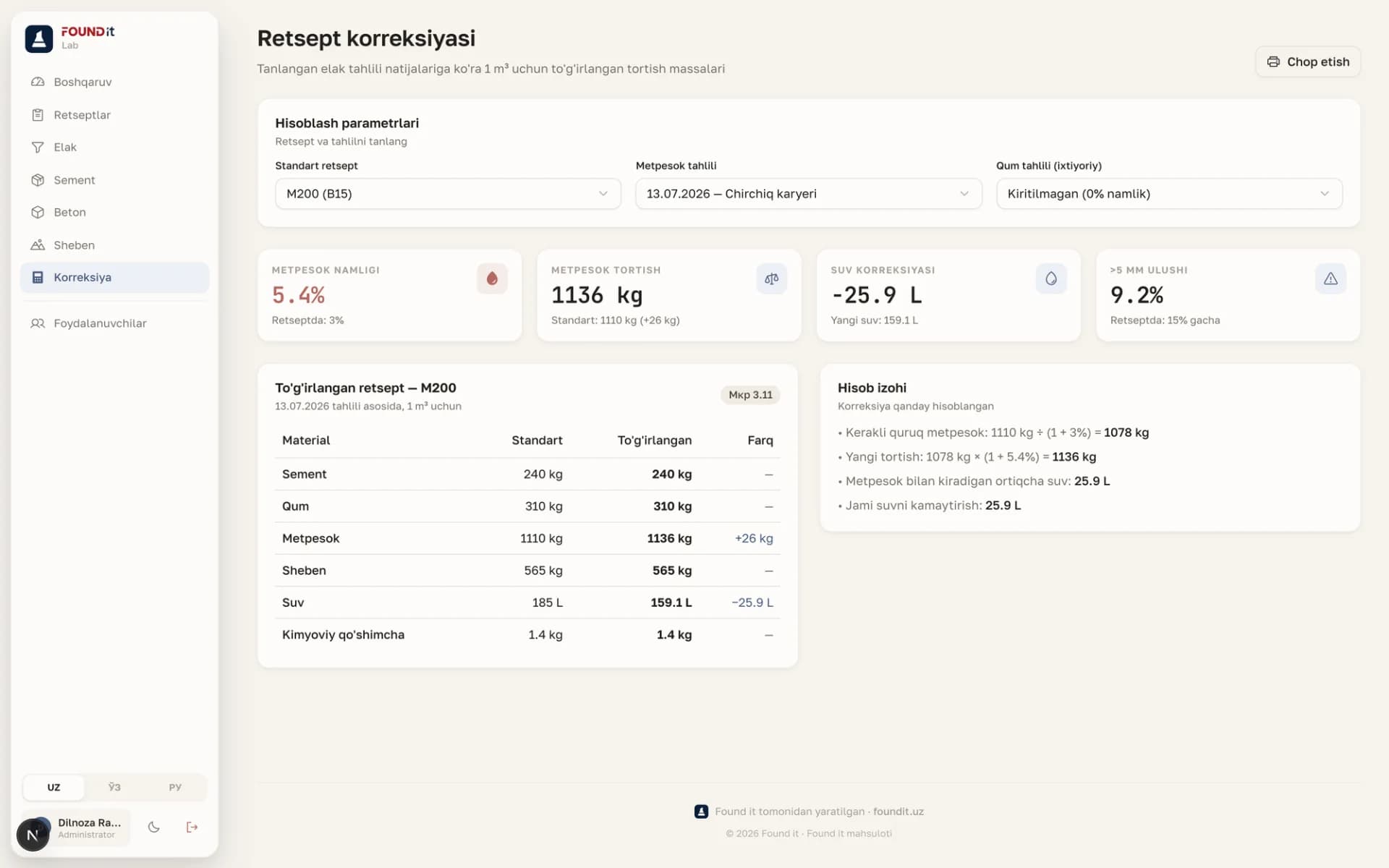
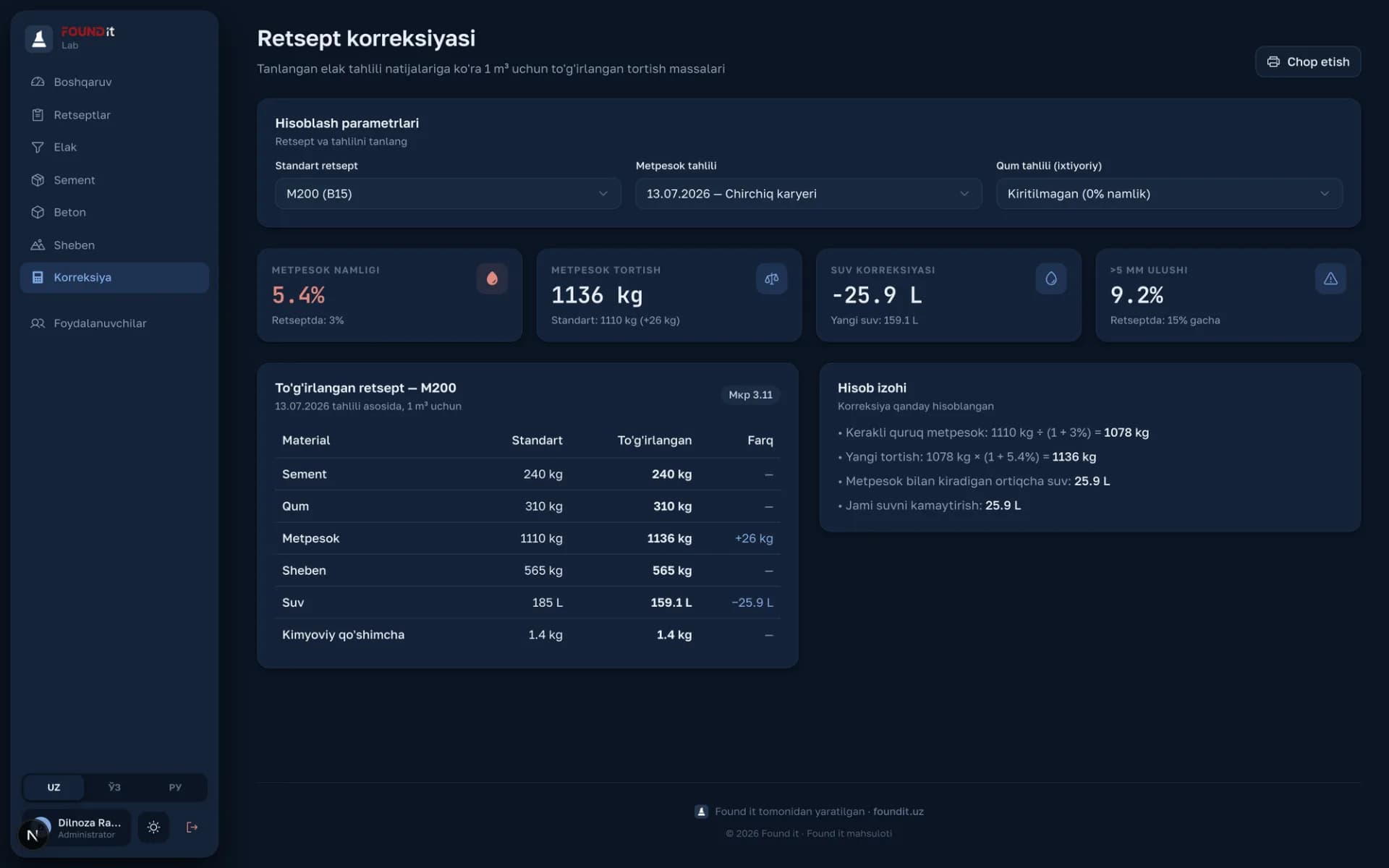
Takes the latest sieve test and recalculates today's weigh-out and water. With the arithmetic shown, so you can check it.
Drift alert
When moisture or the >5 mm fraction exceeds what the recipe assumes, the dashboard says so at once.
Automatic GOST verdict
For every test: conformity, class, and a list of warnings with the reason for each.
Three languages
Uzbek Latin, Uzbek Cyrillic and Russian. Standards terminology stays in its original form, because that's what technicians know.
Roles
Administrator and lab technician. Only the administrator manages users.
One journal
Every test in one database, with search, filters and paging. The notebook can't go missing.
On your server
Runs on a server inside the plant. Nothing leaves the building.
How much sand and water go in today?
The mix design is written for dry material, and the sand in the yard is wet. Eyeballing the difference is how a batch loses its strength class. The system does the arithmetic.
- Takes the real moisture from the latest sieve test (say 5.4%, against the 3% the recipe assumes)
- Works out the dry mass, then the new weigh-out for today's moisture
- Calculates the extra water riding in with the sand and subtracts it from the mix water
- Every number is shown in a "how this was calculated" panel, so it can be checked
- If there's excess >5 mm material, it proposes rebalancing sand against crushed stone
- Print the result and hand it to the batching operator

Pricing
Clear pricing, no hidden fees
A plant-grade system: every GOST calculation and the installation are in the price. Data migration and technician training start at the Plant tier.
Lab
A single lab, up to 5 people
2 400 000so'm/mo
- 1 lab, up to 5 users
- Sieve, cement, crushed stone and concrete tests
- Automatic GOST verdicts
- Standard mix designs
- Batch correction calculator
- Drift alerts
- Three languages: Uzbek (Latin/Cyrillic) and Russian
- Support over Telegram
Plant
A full production lab
4 800 000so'm/mo
- Unlimited users
- Everything in Lab
- Installed on your own server
- Migration from the paper journal
- Mix designs and limits tuned to your plant
- Staff training
- Priority support
Enterprise
Several plants or branches
9 600 000so'm/mo
- Multiple plants (each its own installation)
- Everything in Plant
- New test types and reports built to order
- Integration with your existing ERP or 1C (bespoke)
- SLA and 24/7 support
- Ongoing technical support
Prices exclude VAT. Pay yearly and get 2 months free. The price covers one plant — each additional plant is a separate installation.
FAQ
Frequently asked
See FOUND it Lab on your own work
We'll come to the plant or show you online. If you like, we'll enter your own mix design and latest sieve test and compute the correction live.
All products